
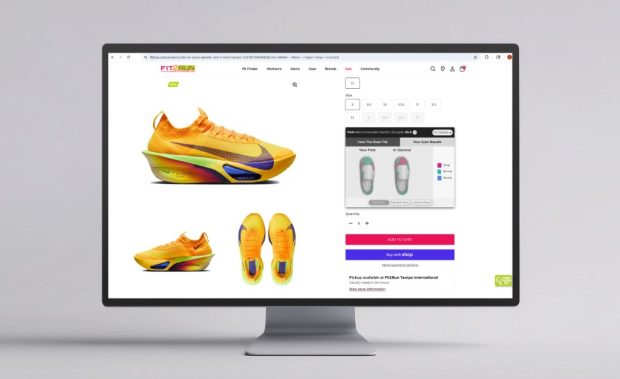
If the shoe fits…good things usually happen. That’s being verified by Aetrex’s FitAI technology. The Teaneck, NJ–based company’s proprietary Albert Pro and Zoe Pro 3D foot scanning machines and accompanying AI software are amassing huge amounts of size data (two million-plus consumers and counting across 500-plus stores) and matching it with 3D shoe scans by brand and style. The resulting fit accuracy equates to 45 to 60 percent average engagement rates, far fewer returns, increased revenue, and customers being five times more likely to return to stores with Aetrex AI-powered footwear recommendations.
Aetrex CEO Larry Schwartz (pictured below) says the goal of FitAI is to equip sales associates with a tool to guide consumers to the right fit for their feet, effectively building purchase confidence and promoting better foot health. Mission being accomplished.
“FitAI provides a data-driven complement to the traditional sales associate interaction, offering a more detailed and consultative engagement that elevates the retail experience both in-store and online, enhancing brand loyalty,” Schwartz explains, noting that retail partners currently include DSW, Fit2Run, Asics, Puma, and The Runner’s Superstore. The resulting higher opt-in rates also help retailers gather valuable first-party data. “Retailers can use that data to segment their audience and send hyper-targeted content—such as personalized shoe recommendations by style and brand based on their foot scans—which can lift revenues,” he adds.
Another way to increase revenue is by lowering return rates. FitAI partners, like Lehigh Outfitters, have reduced return rates by up to 50 percent. (Click here for the case study.) “Lowering return rates can have a large, multi-layered impact on a retailer’s business, sometimes representing the difference between a profitable year and a loss,” Schwartz says, noting that for every $100 in sales, retailers can lose approximately $16 to $30 to the hidden costs of returns.
With each scan, Aetrex’s FitAI database gets more comprehensive and, therefore, more precise on size recommendations. Schwartz believes it’s a game-changer for the industry. “Until this technology, shoe fitting was based on trying to take a single linear dimension of a complex shape and then picking the right shoe match,” he says. “FitAI uses 3D volumetric data to compare your foot to the actual internal space of the shoe. This effectively standardizes the entire industry’s inventory for the individual consumer, replacing generic sizes with accurate, personalized shoe recommendations tailored to their unique foot profile.”
Schwartz says FitAI is way ahead of forecast since debuting in 2024. It has moved quickly from a pilot program with select retail partners to a period of high-velocity growth. (A full list of retailers with Aetrex 3D foot scanners can be found here.) “The primary driver has been the rapid expansion of our SmartLast database, which now gives us a significant competitive advantage in 3D-scanned footwear data,” he says. “Over the last six months, our growth has accelerated to the point where we’re now operating well ahead of our original 2024–2025 roadmap.”
How FitAI works
Step 1: A retailer sets up an Albert Pro or Zoe Pro 3D foot scanner, sharing its digital product feed with Aetrex, which is then matched against the proprietary SmartLast database of 3D-scanned footwear in inventory. If fewer than 75 percent of the products are in the database, Aetrex scans additional shoes from the retailer’s inventory at an Aetrex Fit Lab.
Step 2: Consumers get their feet scanned at stores, and FitAI software displays personalized fit ratings ranging from “excellent” to “poor.”
Step 3: Once a retailer matches 5,000-foot scans to in-store purchase-matching data points, FitAI can be made available online, allowing shoppers with a completed scan to log into a retailer’s website and receive personalized fit recommendations.
Retailers interested in learning more about Aetrex FitAI can book a demo here.
The post Fit to Be Tried appeared first on Footwear Plus Magazine.